Minggu, 18 September 2011

Sunday Poetry XLI -- Chimney-Sweeps

As most of you know, I am now in law school.  While I embrace the material (and it is, truthfully, remarkably exciting and engaging stuff), I definitely miss my regular indulgence in the otherwise finer literatures of fiction and poetry.  And what with the extraordinary quantity of reading I’m doing, and that just simply to keep afloat, I feared I’d never—at least for these next three years—be able to, well, take to calmer, more artistic waters.  It turns out my fear is only mostly affirmed; while I certainly don’t have time to read much else of anything save the Law, such studies recall with not inconsiderable frequency the general, essentially mundane, but overall poignant, concerns and citizenry that inspire pretty much everything any great author has ever treated.  Property Law has done it now, and with significance, twice (I mentioned it over at my other blog, should you care to look).  Wednesday, it recalled, though less directly even than Kafka, William Blake.

A London chimney-sweep, whose title, we’re lead to assume from the judge’s opinion and holding, was superior in the boy than as to any previous owner (save, of course, the mythical first owner who never appears in such cases), found a jeweled brooch.  While the case further disregards the socio-political treatment and purview of the little dirty boys hired out, Dickensian-style, to the upper and middle classes of the citified home-owners, we do get a glimpse of it out from between the lines.

The boy takes the brooch to a local jeweler for appraisal.  The proprietor's apprentice, who answers his call, claims it worth but a pittance and takes the brooch, awarding the boy the “estimated” cash value.  The boy, however, doesn’t want the money; he wants the brooch, which, naturally, the apprentice refuses.  What I don’t get is what happens next.  Somehow, the chimney-sweep manages to hire a lawyer (and I suspect this speaks more of the tremendous range of class of legal service providers available in London than any likely, or even possible, condescension of the highbrow), and win a judgment from the court awarding him something like 65 pounds.  Those of you who know at least as much as the little bit I do about 19th century money in England should get the significance of this.  What you may not get is the true earth-shaking-ness that this award was landed by a chimney-sweep!

Perhaps Blake can give an indication.

If you’re unfamiliar with Blake’s Songs of Innocence and Experience (essentially parallel pieces exploring the differences in life and the examination thereof as dependent upon Reader's perspective, that of innocence or experience, or the given situation in life, chiefly by age, which is, of course, always some point along the continuum between either innocence or experience), I highly recommend you read them—a lightning fast read, even if you take the time to get what he’s doing.  I’m not going to get into it all here, but at least be aware that Blake understood, and with the aforementioned Dickensian perceptivity, what life meant to a chimney-sweep boy: something as black and hopeless as the soot they’re coated in.  Oh, and the mortality rate was staggering!  Yeah, and they were kept in small herds by pimps who often beat and abused them.  (Okay, I’ll stop.  Enjoy the poetry.  They, are, I think, some of the very finest there are, and certainly among my favorites.)

The Chimney-Sweeper
by William Blake
from Songs of Innocence
When my mother died I was very young,
And my father sold me while yet my tongue
Could scarcely cry ‘weep! ‘weep! ‘weep!
So your chimneys I sweep, and in soot I sleep.

There’s little Tom Dacre, who cried when his head,
That curled like a lamb’s back, was shaved: so I said,
“Hush, Tom! Never mind it, for when your head’s bare,
You know that the soot cannot spoil your white hair.”

And so he was quiet; and that very night,
As Tom was a-sleeping, he had such a sight, —
That thousands of sweepers, Dick, Joe, Ned, and Jack,
Were all of them locked up in coffins of black.

And by came an angel who had a bright key,
And he opened the coffins and set them all free;
Then down a green plain leaping, laughing, they run,
And wash in a river, and shine in the sun.

Then naked and white, all their bags left behind,
They rise upon clouds and sport in the wind;
And the angel told Tom, if he’d be a good boy,
He’d have God for his father, and never want joy.

And so Tom awoke; and we rose in the dark,
And got with our bags and our brushes to work.
Though the morning was cold, Tom was happy and warm;
So if all do their duty they need not fear harm.

*

The Chimney-Sweeper
by William Blake
from Songs of Experience
A little black thing among the snow,
Crying! ‘weep! weep!’ in notes of woe!
‘Where are they father and mother? Say! —
“They are both gone up to the church to pray.

‘Because I was happy upon the heath,
And smiled among the winter’s snow,
They clothed me in the clothes of death,
And taught me to sing the notes of woe.

‘And because I am happy and dance and sing,
They think they have done me no injury,
And are gone to praise God and His priest the king,
Who made up a heaven of our misery.’

*

Once enough, you think?  Read them again.  Examine the poetic conventions that hold them together.  Look at how they compare, one to the other.  How do they fit within their respective collections, “Innocence” and “Experience”?  Who is Blake’s audience—is it multifaceted?  What is he saying to those who read?  Are the chimney-sweepers part of that audience? 

Minggu, 28 Agustus 2011

Sunday Poetry XL -- "The Third Coast," 1979


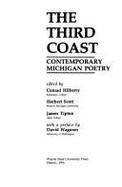
There is no more sure-fire way to ensure the "datedness" of a book than subtitling it, in part, with the word "contemporary," in this case, "Contemporary Michigan Poetry," another book, very much like You've Been Told, from a couple weeks ago, that I have (didn't buy, but inherited) but haven't read.  So, today, I will peruse the collection and, in real time, randomly choose three poems.  Here they are, contemporary or not, in all the glory (your thoughts are welcome):

Death and the Pineapple
Dan Gerber, pp 57-58
The fruit itself a giant pinecone
Texture of an apple     the taste
An apple flavored with pine
If I died I couldn’t eat pineapples
Couldn’t slice them with a large knife
Or say the word that conjures the taste
Pie-napple     pine-apple
Couldn’t run my hands
Down the rough sides
Or over the bushy top
Let its juice drizzle down my chin
Or wipe it away
With the back of my hand
Rub it in my hair     gargle it
Ponder the origin of its name
Throw it at a strange and beautiful
Woman on the rue Saint-Jacques
Imagine a trip to Hawaii

The pineapple
Is what we give up when we die
Along with strawberries     coffee and sun
The room hovers about me
One more skull
The trees around the house
The sky around the tree
The stars around the sky
How could I escape so many enclosures
What would I see
What tastes     what sins
And if existence exists in space
What space     I can’t imagine nothing

A house I once visited
Had a pineapple over the door
A pineapple over the newel post
A pineapple in the center of the table
Surely these people had lived
They said it was their family crest
My sign     my life
A galaxy of pineapples

I considered all the pineapples
Growing under the sun
And will enjoy the good of my labor
All the days of my pineapple
For there is a wicked man
Who prolongeth his pineapple
In his wickedness
And not a just man on earth
That doeth good and sinneth not

In the Winter of Tigers
Tom McKeown, p150
In the winter of tigers,
After the zoo closes, the sun
Smokes and thins out, seeds
Leap from an apple’s core,
Wheat whispers loudly
To the earth, to startled snow.

A crow plummets
Through the calm sky
Like a black parachute
That never opens.

In the middle of winter, the tigers
Walk up the snowy mountains
And spread out with the snow,
Until there is only snow and tigers,
And the memories of tigers,
Invisible against the snow.

At St. Mary’s for the Aged
Eve Shelnutt, p235
She thinks God wants a wife.
She would like to lie with Him.
Would He make her pretty,
Or take her as she is?
Where, around Him, do the arms go?

The jealous Sisters see her rise;
Their hands cross on the door.
She dies and, dead,
Is not denied.
The Sisters lifting bones
Are satisfied.

Minggu, 21 Agustus 2011

Sunday Poetry XXXIX -- Robert Ripley and Poetry (KAY RYAN)

I'm about to go back to school.  Again.  Third time's a charm.  I hope.  The preparations of which have made it near impossible to maintain my once-steady stream--or flooding river, really--of posts and commentaries and questions.  Be that as it may, and trying to think of something for today's installment of Sunday Poetry, I remembered a silly verse I once read in the original Ripley's Believe It or Not--something about school and the futility of studying.  I can't remember the exact verse, and as the book is buried in a box somewhere out in the garage, yet unpacked, I took to Google and the great gaping expanse of the www.  I did not find what I was looking for, as is often the case, and as is as often or even oftener the case, found something even better: a poem from a Pulitzer Prize-winning collection by a poet, former poet laureate Kay Ryan, inspired by Ripley's reported oddities.  Here is the title work:

The Jam Jar Lifeboat 
invented in 1831 by a man named Bateman who 
insisted it was unsinkable, sank the first time it was tested. 
Ripley’s Believe It or Not! 
It was quixotic to think
the cold grey North Atlantic
might be survived in a jam jar boat.
It is not enough that one of something
can be made to float with its lid sealed tight.
One rat might survive one night
on a single treadmill bottle
but even that would be a battle.
Bateman always hated how small truths
extrapolated so poorly. He came up with
really good small ones almost hourly.

Minggu, 14 Agustus 2011

INVISIBLE CITIES XXXIV -- Chapter 5, ..... 1

(I know it's self-indulgence, but I can't help but think of T.E. Hulme's "Above the Dock," reading the Khan's description of the moon's progression in his dream.)
  1. If a person is, or may be[come], master of his/her domain, and if Kublai Khan's entire empire exists merely--or maybe just possibly--as words and dreams, mightn't any person gain leadership of grand empire?

  2. What of the notion that the Khan's empire is so huge and that it's impossible for him to ever visit all the cities?  Is this and Polo's descriptions anything like the famed tree that falls in a forest with no one to hear?

  3. Regarding the structure of the book, do the opening expositions to each chapter--the situation the Khan finds himself in--dictate the meme of Polo's coming descriptions?  (And any thoughts at all on how much time passes during or between each chapter?)

Sunday Poetry XXXVIII -- "YOU'VE JUST BEEN TOLD"

One of the many great things about being a teacher, or English teachers, anyway, and especially for those working in old buildings, is book inheritance.  Pretty much every time a teacher changes classrooms, especially in the case of assuming the former classroom of a now-retired English teacher, is the mass of books left behind.  Sometimes hundreds.  Really.  Literally.  Over the last ten years, I have been the move-inner to the former space of three departed English teachers and have duly reaped the literary benefits.  (Of course, I assume that these teachers left behind only the books they didn't want to take home with them, but still, I've scooped up some pretty awesome windfalls.)

As all of my favorite books are boxed up in the garage, and as I used some of my less-favorite books as buffers in the stacking and packing before the drive eastward, which books are not in boxes, it is from this latter pile (quite, again, literally, I'm sorry to say) that I draw today's material: You've Just Been Told, by one Elizabeth Macklin, whose book has just been out in the garage, unprotected, alone, and (oh, I'm embarrassed) left on the concrete floor.

I've never read any of Macklin's poetry.  I kept the book because, honestly, it looked nice and, originally, I thought it might serve as potential inspiration for coming English students.  Well, that's out, so I probably ought to determine if the book's worth holding the space it takes.  I will randomly open the book three times--yes, in just the moment between right now and final typing of this sentence--and copy out the three poems I find there.

***and as I crack open the book, it literally crackles.
I don't think it was ever read, even by the former owner[s]***

The Lazy Girl Was Never Scolded
(p58)
Then: New-painted ceilings shed light, in our place,
as if they were living, or holy/  That smell was early

spring, with the windows open.  Ambition was only
sleeping, or shortly to be awakened, and would not disappear

forever into compliant ambition.  One time, I sat down
on the steps of a ladder, holding a cup of black

coffee that nearly woke the world.  Paint was spread bright-
yellow into the corners.  Turpentine curled

from woodwork and settled.  I did not sit straighter.
A willow outside the window reeked in the sun of doing

nothing, up in its branches, its leaves whole stories,
all summer.  A long blond girl, dark in the backlight,

I seized what is nowadays made to seem
nearly nothing.

Almost
A qualifier of superlatives
(p29-30)
How much of this
was misunderstanding--
how much was almost blindness?
We did math at the table

almost forever.  Or I "helped"
around you finicking chores.
I almost certainly thought
you couldn't see me.

You almost always said
yet again "You with me?"
I was certainly
angry with you.

Dear Old Dad (your almost ironical
nickname; y our invention), explain
our delay in getting the gist
of kindness.  I didn't see you almost

might've but couldn't;
you didn't tell me stories
about your childhood.
You were maybe afraid, almost.

And so, almost maybe, was I.
But beatings, chiggers in Texas,
butter borrowed on welfare
are almost laughable

after a lifetime,
fears of a planet
or angry passion
almost a memory.

Wholly unique (though yes we
have no degrees of uniqueness)
your almost irreconcilable
lifetime:

qualifying the present
and almost the past
by strict, strong, stronger
grammars of attention--

just when you're thinking 
of dying, you marry again,
quickly, almost ecstatic,
trusting at last your almost

perfect decision, your superlative.
Yet almost just as jealous
of each wife, child/children:
how our love is apportioned.

See? I'm almost
with you again.
I'm almost angry
with you again.

At 43, She Thinks What
to Name Her Children
(p84)
Oh . . . Firstborn, Asher!--asher means "happy"--
because I am happy.  Carlyle, Joseph,
Robert and Richard, for family names:
namesakes all unspeakably loved, for all their flaws.

Jean, Margaret, Ila for girls,
to say they were loved, and will be loved.
All of them out of two originals--Margaret Jean,
Ila Margaret--not to be copied.

Or--she hopes, does she?--uncopied by me.
Because not wishing harm on a daughter?
Margaret, Jean, Ila, Margaret--all
speakable now, since now chosen.

Or else--can it be a name for a woman?--
the lastborn, Asher: no, possible Asher,
"Do what you can--I love you, Asher,"
because I'm alone but I am happy.

Rabu, 10 Agustus 2011

INVISIBLE CITIES XXXIII -- Chapter 4, ..... 2


Have we arrived at 
the process Calvino employed 
to "create" each of his cities?

*


INVISIBLE CITIES XXXII -- Cities and Names: AGLAURA

  1. Aside from providing a potential pair of names for Calvino's book, what inspiration is there for the account of this particular city in the plot description, or anything else in the description, of the play Aglaura, as put up by Wikipedia?

  2. As the others in chapter four, is Aglaura a double city, or a city accompanied immediately by its reflection?

  3. Polo's cursory description of the city identifies it as remarkable only by its drabness--by its unremarkableness, yet he claims the periodic and spontaneous appearances of things "unmistakable, rare, perhaps magnificent."  In the context of any other city, would these spontaneities be less remarkable?