Tampilkan postingan dengan label IC Chapter 5. Tampilkan semua postingan

Senin, 16 Januari 2012

INVISIBLE CITIES XL -- Cities & the Dead: MELANIA

This is the first city characterized as "Cities and the Dead."  What do you make of it's placement?

I really don't have a lot to say about this one.  I could probably dig into it and find something more than what I've got, but I'm not going to do it this time.  It's not that it's too pretty (it's not, really), or that there's too much there to get into (maybe there is, but I don't think so).  I don't know.  Maybe I'm just lazy.  I'll limit it, instead, to just a simple application fitting it--squeezing it, it seems--into the spider theme we've had going this chapter:

If Melania might fit into the spider theme, it can only be that all these citizens who die and are replaced or renewed or replayed are the spiders.  While I'm not convinced this is what Calvino had in mind at all, it makes for an interesting shift from beginning of the chapter to end: that we started with the spider as the God--the emperor--and now end with the spiders as the citizens.  Thoughts?

The name, Melania, by the way, is Greek for black or dark.  Go figure.

INVISIBLE CITIES XXXIX -- Cities & Names: LEANDRA

Only because I've referenced him recently, 
here's Arthur Rackham's Puck, from
A Midsummer Night's Dream.
As is generally the case, I started with the name of the city: Leandra, and went to behindthename.com, my old standby.  This is what I found (not what I expected, considered the arachnoid theme of chapter 5 and that Leandra, the city, seems to match): 

From the Greek Λεανδρος (Leandros) which means "lion of a man" from Greek λεων (leon) "lion" and ανδρος (andros) "of a man". In Greek legend Leander was the lover of Hero. Every night he swam across the Hellespont to meet her, but on one occasion he was drowned when a storm arose. When Hero saw his dead body she threw herself into the waters and perished. 


Cool little story, huh?  But there are two more names as well, the species of the two gods that rule here:
  • Lares (I love this one -- all from Wikipedia, and perfectly appropriate to Polo's description (or Kublai's) of Leandra):  "Lares are sometimes categorised as household gods but some had much broader domains. Roadways, seaways, agriculture, livestock, towns, cities, the state and its military were all under the protection of their particular Lar or Lares."  (See the rest of it here.)
  • Penates (which seems to me a variation of the lares):  Penates "were among the dii familiares, or household deities, invoked most often in domestic rituals. When the family had a meal, they threw a bit into the fire on the hearth for the Penates.[1]They were thus associated with Vesta, the Lares, and the Genius of the paterfamilias in the "little universe" of the domus."  (See the rest here.)
(The opposite of a puck, maybe, despite the cross-cultural leap such a connection would require?)

Now, all that said, what do you make of the fitting of this chapter and the "gods" into the spider theme?  

(Living in a particularly old house as I do, which is infested with spiders in the summer and ladybugs in the winter, the connection seems obvious and, yeah, nerdy, gleeful.

Minggu, 15 Januari 2012

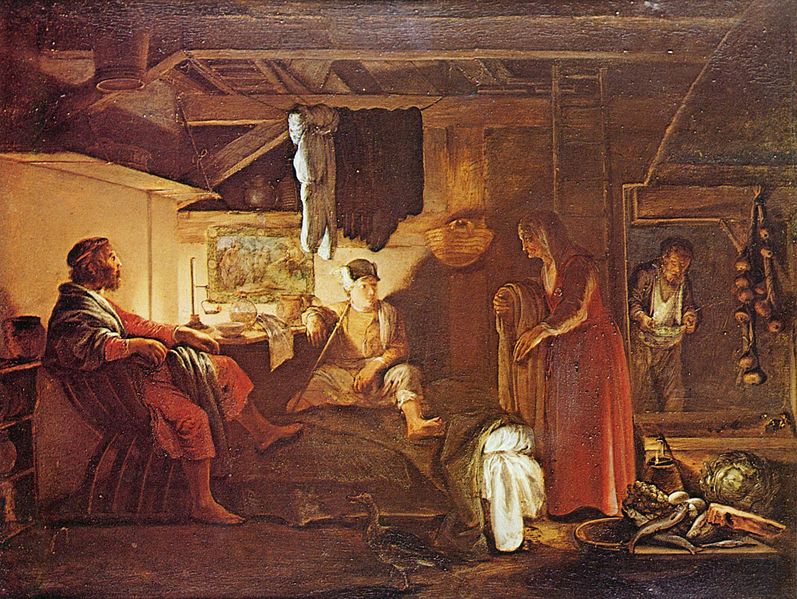
INVISIBLE CITIES XXXVIII -- Cities & Eyes: BAUCIS

Jupiter and Mercury in the house of Philemon and Baucis
We've spent the last two cities talking about spiderwebs and how the metaphor may or may not apply to the Khan's far-reaching, and perhaps tenuously maintained, empire.  It took me a few minutes (and certainly well after the first read nearly ten months ago now) to see what's going on in Baucis.  More than just the subject of the imagery is the scale of it all.  Before we get to punch line, then, let's look at the city's description in reverse:

The 3 hypotheses:
  • "that they hate the earth";
  • "that they respect it so much they avoid all contact"; and
  • "that they love it as it was before they existed and with spyglasses and telescopes aimed downward they never tire of examining it...."
The description:
  • A number of great stilts like flamingos' legs supporting the city, which, on a sunny day, casts and angular shadow;
  • and perhaps this one is stretching it, but check out how long it takes to get to the city: not seven days does it take, but only after seven days do you arrive there, and what, of course, comes after seven?  And then immediately the mention and description of the long slender stilts reaching up into the heavens?
A spider, right?  And not just any spider, but a spider so lofty as to dwell in the heavens, where only the gods and, perhaps, at least one of the greatest of emperors reside, right?

Interesting that the citizens of the city never descend, as they have everything they need with them, yet they leave ladders out for those who may desire an ascent a means of access.  

As far as the name is concerned, Baucis, I'll let you draw your own conclusions.

Jumat, 13 Januari 2012

INVISIBLE CITIES XXXVII -- Trading Cities: ERSILIA

Ersilia and Romulus; from here
In Ersilia we have another web, though there's nothing necessarily spidery about it, as was the case in Octavia.  I don't know if Calvino meant it (I was more sure that he didn't mean a connection to Shelob, of course), but this chapter reminds me of something I read about in Chabon's The Yiddish Policemen's Union.  In the book, the protagonist has a scuffle with the "Black Hats" -- a sect of a particularly strict observers of Judaism.  Now, I'm the first to admit that I know practically nothing about Judaism.  Really pretty much only what I've gotten from Chabon's books and a few read-throughs of the Old Testament.  It's been long enough since my last read of The YPU that I don't remember the details, but somewhere along the line, the protagonist has to speak to the guy who manages all the string.  Yeah.  Anyway, this guy is a master of all the boundaries put upon strict observers of Jewish law and marks them all on hundreds of maps and uses dozens of types and countless lengths of string to run throughout the town and demarcate the boundaries (how many steps one may take on the Sabbath, for example) for observers.  Anyway, the webs in Ersilia remind me of this, and I'm very interested in what you might make of it.

A few other things I find interesting, and about which I invite your thoughts:
  • that the strings remain when the inhabitants leave;
  • use of the word "refugee" and how it connects not only to the story of Ersilia itself, but also to the meta-story of the empire;
  • that the bones don't remain, victims of the rolling wind, and in the same sentence of the mention, finally, of a spider (as if the spider ate the bodies whose bones are gone);
  • lastly, Ersilia was the wife of Romulus -- you know, of Remus and Romulus, founders of Rome, another empire and also stretched particularly thin.

INVISIBLE CITIES XXXVI -- Thin Cities: OCTAVIA

from here
It's been months since the last IC entry.  An unexpected impetus, however, struck, and I'm back.  No need to dwell on it; let's just jump back into it.

This chapter offers an obvious knee-jerk reminder--certainly and thankfully ridiculous--of a Spiderman villain, and perhaps less so, one from The Lord of the Rings.  Maybe if I hadn't taken a four-month hiatus, I wouldn't have had to reread the exposition at the head of chapter 5 to get what's going on.  We examined a little bit over the previous four chapters the subtle shifting--or, at least, the unlabeled shifting--of narrators.  I'm not sure who's dream is Octavia, or, for that matter, that of the next two chapters (though I expect the entire chapter, whoever's dream it is, is the same), but clearly it's commentary on the unchecked expansion of the empire.

  • Assuming that Octavia is analogous to all of the Kublai's expansive territories, what do you make of the closing sentence?
by John Howe; from here

Minggu, 14 Agustus 2011

INVISIBLE CITIES XXXIV -- Chapter 5, ..... 1

(I know it's self-indulgence, but I can't help but think of T.E. Hulme's "Above the Dock," reading the Khan's description of the moon's progression in his dream.)
  1. If a person is, or may be[come], master of his/her domain, and if Kublai Khan's entire empire exists merely--or maybe just possibly--as words and dreams, mightn't any person gain leadership of grand empire?

  2. What of the notion that the Khan's empire is so huge and that it's impossible for him to ever visit all the cities?  Is this and Polo's descriptions anything like the famed tree that falls in a forest with no one to hear?

  3. Regarding the structure of the book, do the opening expositions to each chapter--the situation the Khan finds himself in--dictate the meme of Polo's coming descriptions?  (And any thoughts at all on how much time passes during or between each chapter?)