Tampilkan postingan dengan label tigers. Tampilkan semua postingan

Minggu, 28 Agustus 2011

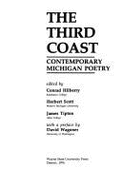
Sunday Poetry XL -- "The Third Coast," 1979


There is no more sure-fire way to ensure the "datedness" of a book than subtitling it, in part, with the word "contemporary," in this case, "Contemporary Michigan Poetry," another book, very much like You've Been Told, from a couple weeks ago, that I have (didn't buy, but inherited) but haven't read.  So, today, I will peruse the collection and, in real time, randomly choose three poems.  Here they are, contemporary or not, in all the glory (your thoughts are welcome):

Death and the Pineapple
Dan Gerber, pp 57-58
The fruit itself a giant pinecone
Texture of an apple     the taste
An apple flavored with pine
If I died I couldn’t eat pineapples
Couldn’t slice them with a large knife
Or say the word that conjures the taste
Pie-napple     pine-apple
Couldn’t run my hands
Down the rough sides
Or over the bushy top
Let its juice drizzle down my chin
Or wipe it away
With the back of my hand
Rub it in my hair     gargle it
Ponder the origin of its name
Throw it at a strange and beautiful
Woman on the rue Saint-Jacques
Imagine a trip to Hawaii

The pineapple
Is what we give up when we die
Along with strawberries     coffee and sun
The room hovers about me
One more skull
The trees around the house
The sky around the tree
The stars around the sky
How could I escape so many enclosures
What would I see
What tastes     what sins
And if existence exists in space
What space     I can’t imagine nothing

A house I once visited
Had a pineapple over the door
A pineapple over the newel post
A pineapple in the center of the table
Surely these people had lived
They said it was their family crest
My sign     my life
A galaxy of pineapples

I considered all the pineapples
Growing under the sun
And will enjoy the good of my labor
All the days of my pineapple
For there is a wicked man
Who prolongeth his pineapple
In his wickedness
And not a just man on earth
That doeth good and sinneth not

In the Winter of Tigers
Tom McKeown, p150
In the winter of tigers,
After the zoo closes, the sun
Smokes and thins out, seeds
Leap from an apple’s core,
Wheat whispers loudly
To the earth, to startled snow.

A crow plummets
Through the calm sky
Like a black parachute
That never opens.

In the middle of winter, the tigers
Walk up the snowy mountains
And spread out with the snow,
Until there is only snow and tigers,
And the memories of tigers,
Invisible against the snow.

At St. Mary’s for the Aged
Eve Shelnutt, p235
She thinks God wants a wife.
She would like to lie with Him.
Would He make her pretty,
Or take her as she is?
Where, around Him, do the arms go?

The jealous Sisters see her rise;
Their hands cross on the door.
She dies and, dead,
Is not denied.
The Sisters lifting bones
Are satisfied.

Minggu, 16 Januari 2011

Sunday Poetry XI -- TIGERS: GRR


SIRENS, TIGERS, and DREAMS, OH MY! and monsters too.


thank you: Chelsea Art Museum
Yeah, yeah.  I know.  Corny.  Hackneyed.  Irresistible.  But if you disregard the first of the trio, then it's likely smackingly obvious where this post is going, and, well, since the sirens really don't have that much to do with it, probably it is.

Francisco de Goya said, or painted really, "THE DREAM OF REASON BEGETS MONSTERS," in his etching to the right, and certainly in his head it did, and he painted them for the world to see.  Monsters is not a new topic here at The Wall, and I am not (thank me later) going to bore you by getting into it again.  The point isn't the monster, but the dream that produces it.  Perhaps all of us, rational or not, yet beget monsters--more or less monstrous--through our dreams.

Consider the first four stanzas of Margaret Atwood's "Siren Song" (taking the poetry's intent likely far from its originally intended context):

This is the one song everyone
would like to learn: the song
that is irresistible:

the song that forces men
to leap overboard in squadrons
even though they see the beached skulls

the song nobody knows
because anyone who has heard it
is dead, and the others can't remember.

Shall I tell you the secret
and if I do, will you get me
out of this bird suit?

(I wonder if the deliberate removal from context and subsequent application of a quotation is anything like the deliberate and maligned censoring of an author's published words.  If so, I am guilty, guilty, guilty.)

Goya
Good poetry is like a dot-to-dot in one of those coloring/activity books I buy my kids to keep them quiet in church.  The dots, obviously as there but the connecting of them is left to the reader.  While I'm in no way claiming any of this (my words) as poetry, much less good poetry, I am leaving the majority of dot-connecting to you--one poem, quotation, and painting to the next--partially because I think the connections are more profound that way, but mostly because my kids just went to bed (which really means things are supposed to be quiet but they aren't--at all) and I'm having a really hard time focusing long enough to articulate the shortest and most menial of my thoughts.

One of my favorite poems to use in my English classroom, and quite a classic, is "Aunt Jennifer's Tigers" (below), by Adrienne Rich.  It's a great poem, and it's a perfect one to teach because of its abundant use of classic (and by "classic," here, I mean all the required stuff that shows up all over state boards of education English curricula) poetic devices.  All that aside, sure the poem is beautiful, but pay attention to the tigers, the dreaminess, and how, really, they're indeed monsters from the dreams of a rational or reasonable mind:

Aunt Jennifer's tigers prance across a screen,
Bright topaz denizens of a world of green.
They do not fear the men beneath the tree;
They pace in sleek chivalric certainty.

Aunt Jennifer's finger fluttering through her wool
Find even the ivory needle hard to pull.
The massive weight of Uncle's wedding band
Sits heavily upon Aunt Jennifer's hand.

When Aunt is dead, her terrified hands will lie
Still ringed with ordeals she was mastered by.
The tigers in the panel that she made
Will go on prancing, proud and unafraid. 

Now put that together with “Dreamtigers,” by another of my all-time favorites, the great Jorge Luis Borges (seriously, if you like any of the stuff we talk about here at The Wall and you haven’t read this guy yet, get with the program!):

In my childhood I was a fervent worshiper of the tiger—not the jaguar, that spotted “tiger” that inhabits the floating islands of water hyacinths along the Parana’ and the tangled wilderness of the Amazon, but the true tiger, the striped Asian breed that can be faced only by men of war, in a castle atop an elephant.  I would stand for hours on end before one of the cages at the zoo; I would rank vast encyclopedias and natural history books by the splendor of their tigers.  (I still remember those pictures, I who cannot recall without error a woman’s brow or smile.)  My childhood outgrown, the tigers and my passion for them faded, but ther are still in my dreams.  In that underground sea or chaos, they still endure.  As I sleep I am drawn into some dream or other, and suddenly I realize that it’s a dream.  At those moments, I often think: This is a dream, a pure diversion of my will, and since I have unlimited power, I am going to bring forth a tiger.
            Oh, incompetence!  My dreams never seen to engender the creature I so hunger for.  The tiger does appear, but it is all dried up, or it’s flimsy-looking, or it has impure vagaries of shape or an unacceptable size, or it altogether too ephemeral, or it looks more like a dog or bird than like a tiger.

***

There is another piece of lit that I think qualifies, potentially, as part of this dot-to-dot, but it's bigger than I've got space her to include, a children's story, frequently banned, entitled, Little Black Sambo. Here’s the link (HERE – scroll down to the story), and then here, too, is the old movie.


*