
Tampilkan postingan dengan label Harry Stephen Keeler. Tampilkan semua postingan
Tampilkan postingan dengan label Harry Stephen Keeler. Tampilkan semua postingan
Senin, 05 Maret 2012

Kamis, 03 Maret 2011
GENRE FICTION: KEELER versus PATTERSON by analogy of METAL
While I tend to avoid for the most part the "lesser" writing of so-called genre-fiction (becoming less and less the case as I continue to find, or am introduced to, examples of the stuff of unimpeachable literary excellence), I have always harbored a taste, and kept it fairly closeted until now, for another strain of genre, this one "musical" (quotes should connote potential for sarcasm) --that of heavy metal. Just like mystery and sci-fi and thriller and horror and whatever else in fiction, so in music there is hip-hop, R&B, grunge, metal, jazz, and so on--ad infinitum, really (just check out that family tree of rock n' roll below).
I have not been quiet about my recent reading of Harry Stephen Keeler's mystery novel, Riddle of the Traveling Skull, which both delighted and astonished me. I am now reading another genre piece, this one by famed genre master ("genre": though not typical of this author; and "master" only if sheer staggering quantity of book sales qualifies one for such a title), James Patterson: his Witch and Wizard (well, it's not really his--some Charbonet character, ghost writer--but has his name on the cover and bigger, which is essentially the same thing, as I can't imagine he'd sign off on it if it didn't at least match his far-from stringent qualifications). While I firmly believe that Keeler surpassed the typecast of his genre (and this by a dense combination of wit, originality, utter abandonment of reality, and a total dedication to his craft), Patterson has murdered it.
Let's keep things as positive as possible, however, at least for a minute, if no more, because, well, Patterson must be doing something right if he's got 200 million books sold, right? W&W is written for teens. Teens have a short attention span (if this sounds like an insult, it's meant to; I don't feel this way about adolescents, but clearly Patterson does). So instead of bogging down the reader with things like exposition and description and even emotion, Patterson simply deletes them. Sure, the more seasoned reader is left with the impression that he's reading a plot summary or liner notes under the panels of storyboard illustrations for in-development B-movie, but teens are eating it up. And, well, it could even be seen as a good introduction to fantasy for new readers, especially because there's absolutely nothing original to it. The book flagrantly steals most obviously and glaringly from The Lord of the Rings and Harry Potter, among many others, including Lev Grossman's The Magicians (any of which is a little like watching some hack in the audition rounds of American Idol attempt a Whitney Houston number--why would he even want to have his book compared to theirs???).
Now, I've never read anything else by Patterson, so take my snap judgments of him with a grain of salt, and I don't plan to, especially after this. I picked up W&W because so many of my students are reading it, and I wanted to be able to talk to them about it. That and it was only 6 bucks at Wal-Mart, and I needed a new book for the bathroom. Perhaps my problem here--because, really, this book is not next door to terrible, but flagrantly squatting in Terrible's moldy boiler room--is that maybe, just maybe, Patterson should have left fantasy alone and stuck with his more practiced genres of thriller and mystery, not to mention his shift of target audience (which audience, teen/young adult, and which genre, fantasy, tend toward the realms of sacred for me, especially in the case of the audience he's infiltrating (maybe I'm just jealous!)). To really get my point across, however, I think I need to paint all this in the vibrant tones of analogy.
When I was a teen, my favorite genre band--hard rock/metal (metal, of course, is a subjective term and has developed significantly over the last thirty years) --was Metallica: slightly more musical than others, certainly more popular, and particularly great for weight-room blasting after track practice. Over the years, of course, I grew up, and slowly grew away from Metallica. In 1999, however, genre buster and genius composer/conductor for the San Francisco Symphony, Michael Kamen, decided to do up a fat concert's-worth of Metallica charts for symphonic orchestra, and charter the band to take the stage right with the strings and brass, winds and percussion.
The result was absolutely tremendous, and I loved it. If pulp mysteries may be perhaps aligned with metal, maybe specifically Metallica, then Harry Stephen Keeler is Michael Kamen: a little bit crazy, a little bit genius, a lot reckless, and totally given up to having fun with what he does best and loves. No matter how crazy, it just freaking works.
James Patterson, on the other hand, and apart from genre shifting yet, is more like pop hard rockers Godsmack, who simply take all the ideas that everyone else has already had, inject it all with a little more sex, a little more violence, and lot more bad language, and sell it to the highest bidder: teenagers. Now imagine, just for a minute and the sake of argument, that a band like Godsmack took something sacred, like, oh, I don't know, Debussy's "Claire de Lune" and translated it to their particular brand of metal? Well, you'd get-- Hold on. Let me repeat that fantasy has more potential for sublimity, I think, than any of the other "genres." Disbelieve me? Take a look at the greats: Lord of the Rings and Ender's Game, a couple of my most mainstream favorites, and Summerland, though it's less well-known, or the brilliant stuff that someone like Margaret Atwood or Lewis Carroll or Louis Lowry or, heck, even Douglas Adams (to name only a few of the dozens of this world's and our history's greats) can do with it. Let's use Lord of the Rings. It's about as obvious for it's brilliance as is Debussy's "Moonlight." See what I'm getting at here? "Claire de Lune" is to Godsmack as Lord of the Rings is to James Patterson.
When it comes right down to it, the idea behind W&W is actually pretty okay, but instead of giving it to Godsmack (because Patterson DID NOT WRITE IT), why not dish it off to a band that can actually play--like a Sevendust or a Tool or a Porcupine Tree (okay, not metal, but it would be awesome) or, yeah, even Metallica? Better yet, why not a Michael Kamen and the brute, masterful force of his orchestra behind him? Because I still like a lot of metal out there. And sometimes, cross-genre translations do work, but I'm sorry: Mr. Patterson, Ms. Charbonnet, yours doesn't.
(Ugh. I'm gonna go read a poem.)
 |
| a graphical history of 40 years' of rock n' roll, from lindsargwatt.com |
I have not been quiet about my recent reading of Harry Stephen Keeler's mystery novel, Riddle of the Traveling Skull, which both delighted and astonished me. I am now reading another genre piece, this one by famed genre master ("genre": though not typical of this author; and "master" only if sheer staggering quantity of book sales qualifies one for such a title), James Patterson: his Witch and Wizard (well, it's not really his--some Charbonet character, ghost writer--but has his name on the cover and bigger, which is essentially the same thing, as I can't imagine he'd sign off on it if it didn't at least match his far-from stringent qualifications). While I firmly believe that Keeler surpassed the typecast of his genre (and this by a dense combination of wit, originality, utter abandonment of reality, and a total dedication to his craft), Patterson has murdered it.
Let's keep things as positive as possible, however, at least for a minute, if no more, because, well, Patterson must be doing something right if he's got 200 million books sold, right? W&W is written for teens. Teens have a short attention span (if this sounds like an insult, it's meant to; I don't feel this way about adolescents, but clearly Patterson does). So instead of bogging down the reader with things like exposition and description and even emotion, Patterson simply deletes them. Sure, the more seasoned reader is left with the impression that he's reading a plot summary or liner notes under the panels of storyboard illustrations for in-development B-movie, but teens are eating it up. And, well, it could even be seen as a good introduction to fantasy for new readers, especially because there's absolutely nothing original to it. The book flagrantly steals most obviously and glaringly from The Lord of the Rings and Harry Potter, among many others, including Lev Grossman's The Magicians (any of which is a little like watching some hack in the audition rounds of American Idol attempt a Whitney Houston number--why would he even want to have his book compared to theirs???).
Now, I've never read anything else by Patterson, so take my snap judgments of him with a grain of salt, and I don't plan to, especially after this. I picked up W&W because so many of my students are reading it, and I wanted to be able to talk to them about it. That and it was only 6 bucks at Wal-Mart, and I needed a new book for the bathroom. Perhaps my problem here--because, really, this book is not next door to terrible, but flagrantly squatting in Terrible's moldy boiler room--is that maybe, just maybe, Patterson should have left fantasy alone and stuck with his more practiced genres of thriller and mystery, not to mention his shift of target audience (which audience, teen/young adult, and which genre, fantasy, tend toward the realms of sacred for me, especially in the case of the audience he's infiltrating (maybe I'm just jealous!)). To really get my point across, however, I think I need to paint all this in the vibrant tones of analogy.
When I was a teen, my favorite genre band--hard rock/metal (metal, of course, is a subjective term and has developed significantly over the last thirty years) --was Metallica: slightly more musical than others, certainly more popular, and particularly great for weight-room blasting after track practice. Over the years, of course, I grew up, and slowly grew away from Metallica. In 1999, however, genre buster and genius composer/conductor for the San Francisco Symphony, Michael Kamen, decided to do up a fat concert's-worth of Metallica charts for symphonic orchestra, and charter the band to take the stage right with the strings and brass, winds and percussion.
The result was absolutely tremendous, and I loved it. If pulp mysteries may be perhaps aligned with metal, maybe specifically Metallica, then Harry Stephen Keeler is Michael Kamen: a little bit crazy, a little bit genius, a lot reckless, and totally given up to having fun with what he does best and loves. No matter how crazy, it just freaking works.
James Patterson, on the other hand, and apart from genre shifting yet, is more like pop hard rockers Godsmack, who simply take all the ideas that everyone else has already had, inject it all with a little more sex, a little more violence, and lot more bad language, and sell it to the highest bidder: teenagers. Now imagine, just for a minute and the sake of argument, that a band like Godsmack took something sacred, like, oh, I don't know, Debussy's "Claire de Lune" and translated it to their particular brand of metal? Well, you'd get-- Hold on. Let me repeat that fantasy has more potential for sublimity, I think, than any of the other "genres." Disbelieve me? Take a look at the greats: Lord of the Rings and Ender's Game, a couple of my most mainstream favorites, and Summerland, though it's less well-known, or the brilliant stuff that someone like Margaret Atwood or Lewis Carroll or Louis Lowry or, heck, even Douglas Adams (to name only a few of the dozens of this world's and our history's greats) can do with it. Let's use Lord of the Rings. It's about as obvious for it's brilliance as is Debussy's "Moonlight." See what I'm getting at here? "Claire de Lune" is to Godsmack as Lord of the Rings is to James Patterson.
When it comes right down to it, the idea behind W&W is actually pretty okay, but instead of giving it to Godsmack (because Patterson DID NOT WRITE IT), why not dish it off to a band that can actually play--like a Sevendust or a Tool or a Porcupine Tree (okay, not metal, but it would be awesome) or, yeah, even Metallica? Better yet, why not a Michael Kamen and the brute, masterful force of his orchestra behind him? Because I still like a lot of metal out there. And sometimes, cross-genre translations do work, but I'm sorry: Mr. Patterson, Ms. Charbonnet, yours doesn't.
(Ugh. I'm gonna go read a poem.)
Minggu, 27 Februari 2011
Harry Stephen Keeler: THE BEST WORST WRITER OF ALL TIME
 |
| The Collins Library edition, by McSweeney's |
The Riddle of the Traveling Skull is exceptional camp--poop with the very highest of all possible polishes; and even going beyond the typically campy camp of my otherwise favorite "popcorn" fiction. On one side, this book is the prototypical, skillfully wrought mystery/thriller, opaquely and gleefully noir, which qualities I love most about my favorite page-turners. What I believe elevates The Traveling Skull, however, over the other, more typically popcorny (read either "popcorn-y" or "pop-corny;" take your pick) fluff of grocery-store trade novel paperbacks is its complete acceptance--think not the mere grudging handshake of a truce between opposing parties (and I have a sneaking suspicion that most popcorn novelists wish they were more and use their best-seller status as justification for their low-brow writing), but a mighty bear hug, brotherly, loving, and hearty--of what it is: ri-freaking-diculous and proud of it! Characters are not based in the bland reality of museum guards or cab drivers or factory employees; they are world-traveling candy salesmen, nouveau luggage designers, and amateur brain surgeons; Bible-quoting con-men, German hypnotists, and shrinking-violets. And they're names! My goodness: Milo Payne, Abigail Sprigge, Sophie Kratzenschneiderwumpel, Mrs. Winterbotham-Higginsbottom, and, my favorite, Ichabod Chang.
And this is all for one book!
Which I just finished.
And which I loved.
And which I will read again and again, like I do all my camp favorites (Preston and Child's Relic and Cabinet of Curiosities, Carr's The Alienist, and Card's Ender's Game (and yes, no matter how brilliant, EG is camp), among them).
Premise: candy salesman, Clay Calthorpe, has just returned from the Philippines, where he has just successfully contracted exclusive purchasing privilege of all the country's Julu berries, and makes his weary way home. By mix-up of two identical, one-of-a-kind (yes) travel bags, and the flubdubbery of one well-meaning German trolley conductor, Clay comes home not with his own bagful of collars, calling cards, and clothes, but a bag carefully packed with a trephined skull, carefully stuffed with a slightly-mushroomed bullet and the carbons of some odds-and-ends poetry. Clay recognizes, despite the hour and his fatigue, what must have happened (the residual adrenaline of a possible mugging--but false-alarm, thank-you-very-much, at least for the time being--certainly assists his faculties of deduction) and seeks contact with the clergyman, who was sitting aside him and whose bag he must have gotten by mistake. From here, well, it all spirals out of control.
The very glee and astounding confidence with which Keeler writes renders the would-be typical mystery (well, not quite typical) into something to be savored, not ripped through in a frenzy (though you get the impression that Keeler wrote it in such fashion--frenzied, like sharks on seals). He is an accomplished word- and sentence-smith, and injects these short strings of words with all the cockeyed imagination and flayling freedom that he does his swollen plot. Though page-turner it was nonetheless, and I read it like I read (is this sacrilege?) Chabon and MacCarthy. Seriously. With Chabon, sentences are jaw-droppingly brilliant, beautiful, and rhythmically perfect; MacCarthy is stark simplicity at its naked best; Keeler's sentences, on the third face of the same coin, are indeed jaw-dropping--equally expert, held against either of these two recognized masters--but with the added bonus of being freaking hilarious!
*
My favorite moment of the book was not penned by Keeler, but his publishers. I have a code: I will not look ahead. Had I flipped through the novel before reading it, I'd have found this already, and it's revelation would have been much less exciting--far less satisfying. Just before the big denouement, comes this page:
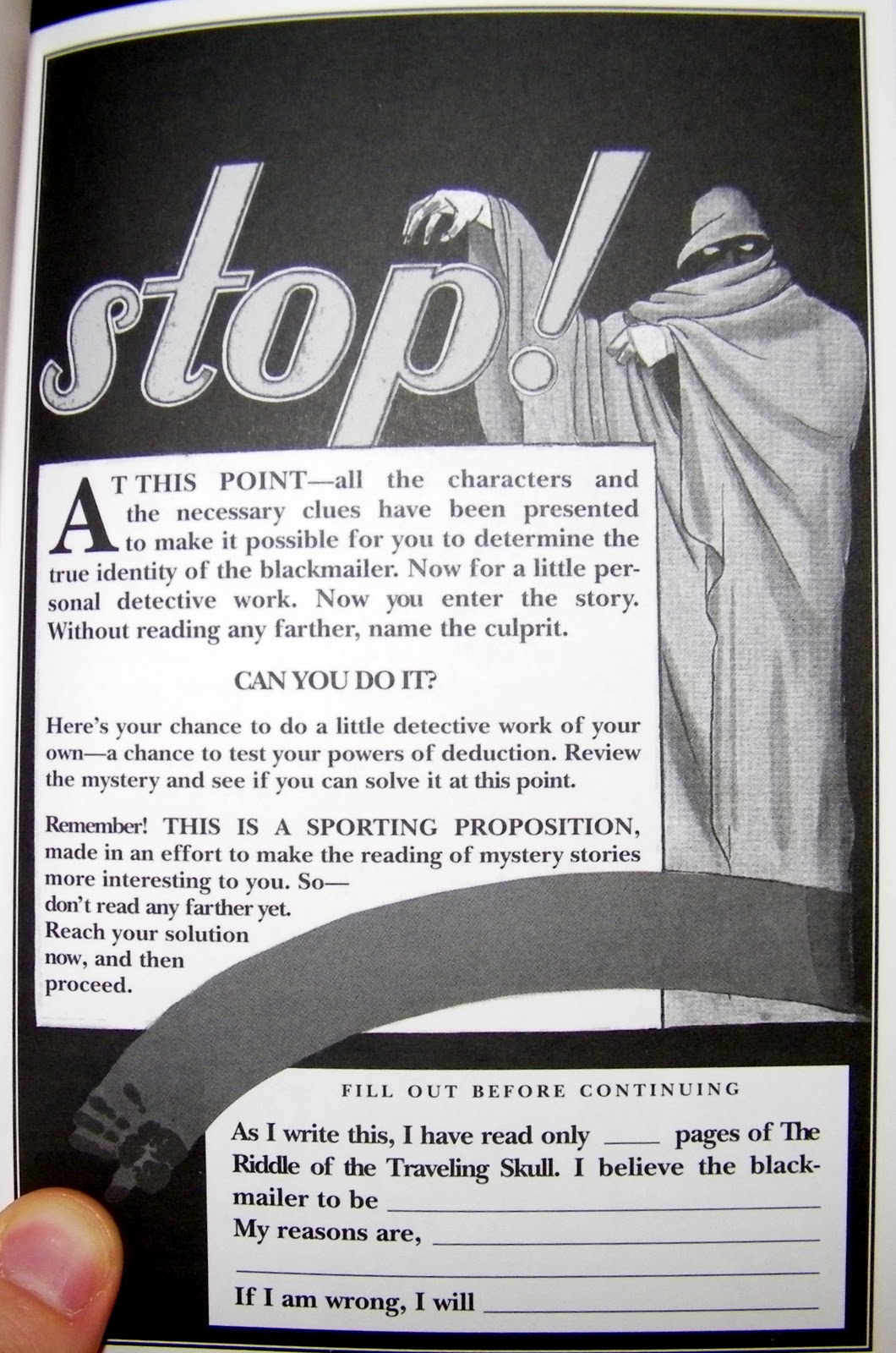 |
| (Please excuse my thumb.) |
Better still, especially considering my interest in becoming a casual expert in Keeler, was the reverse side of this very page, which left me the following note:
Consider a membership in the
Harry Stephen Keeler Society
Since its inception in 1997, the group has grown to some seventy-five members in half a dozen countries. Its organ is Keeler News, appearing five times each year and featuring articles, letters, reviews, and a vigorous emporium of Keeler’s many books. The News has produced fifty issues; all, back to the first, are available. On CD-Rom ($5), the full run comes with the Keeler Dust Jacket Vault, a compendium of original artwork. Mail payments to Richard Polt, [-----] –or consult the internet:
I wrote Mr. Polt, and am now a proud member of the HSK Society (76 members now!). I am excited, particularly, about the Keeler News and the "Read Keeler" link, which, if you so choose, may direct you to Ramble House, which offers nearly everything Keeler ever put to paper and the public--even the stuff never available in English!
In short, get the book, read the book. It is a seriously, hysterically good/fun, ridiculous/diverting read--no, experience.
Kamis, 24 Februari 2011
A PERFECT SIMILE
From The Riddle of the Traveling Skull (again -- I can't help myself -- Is there no end to Keeler's brilliance?):
Context:
A character, blackmailed for murder, seeks refuge without possibility of extradition in a fictional South American country by the name of San Do Mar, with possible plans to stop briefly in New Orleans along the way to await news from his friend. He's worried about cold feet and comments that, "Yes, I--I am in a nervous state. I know it. And once I'm 900 miles or so from my home town, I'll--I'll be in a worse state than ever. I'm even likely to head back to--to Canada--instead of giving the police a chance to pull me off of some United Fruit Company liner," to which the protagonist and the man's friend, not to mention employee, Clay Calthorpe brilliant remarks:
Context:
A character, blackmailed for murder, seeks refuge without possibility of extradition in a fictional South American country by the name of San Do Mar, with possible plans to stop briefly in New Orleans along the way to await news from his friend. He's worried about cold feet and comments that, "Yes, I--I am in a nervous state. I know it. And once I'm 900 miles or so from my home town, I'll--I'll be in a worse state than ever. I'm even likely to head back to--to Canada--instead of giving the police a chance to pull me off of some United Fruit Company liner," to which the protagonist and the man's friend, not to mention employee, Clay Calthorpe brilliant remarks:
"No. You're done for--if you do that.
Canada is as much a refuge for you as--as a
Wisconsin lumber camp is for a lost virgin."
*
*
Selasa, 22 Februari 2011
The Riddle of the Traveling Skull -- EXCERPT
I am deliberately reading this book slowly, because it's just such a stinking good read--ridiculous fun (and you can take that to pretty much accurately call any connotation you want: ridiculous, truly; and fun). I don't know where I'm going to find more Keeler when this one's over, though. This is a limited edition; all the rest are out of print!
Here, 3 tombstones from and a cabbie's description of a red-herring cemetery:
Here, 3 tombstones from and a cabbie's description of a red-herring cemetery:
Here lies the famous
O MING LEE
The Girl with Four Legs and Six Arms
Known to the Profession
as
LEGGA, THE HUMAN SPIDER
Born Canton, China Died Canton, Ohio
1917 - 1937
Erected by the Chinese of America
*
b. 1884 d. 1936
Here lies
GEN. TOM DOWLING
18 inches high
20 pounds in weight
Rest in peace, General!
*
ROSCOE PARKER
He brought happiness and
cheer to the world, with
a heart that, for sheer
nobleness, conformed with
his 612 pounds of weight!
B. 1885 D. 1935
“Well, it’s the cem’tery f’r circus an’ carnival people. And been there about—I guess—four years now.” He was turning the cab about in the width of the narrow crosswise street, but went on talking just the same. “Far more people goes out to see the place, though, out o’ curiosity, than to see their dead ‘uns. ‘Specially since it got wrote up in the newspaper. They go out to read th’ cur’ous tombstones. For they’s one or two o’ every kind o’ person buried there. A midget or two—an’—an’ a giant, to boot! An’ a fire-eater—he’s in the northeast corner—his tombstone says ‘If Hell There Be, He Hath No Fear of It.’ And there’s a couple o’ sword-swallowers. One of ‘em’s grave hasn’t no stone nor nothing—but is set off, all around, with the swords he used in his act—all rusty now, o’ course. And there’s a fat man—and a fat lady, too, somew’eres. And the oldest tent-stake driver in the country—Jed Hopkins—forty years with Ringlings and Barnums—is in another corner. And there’s two—no—three trapeze queens. They don’t live long, y’ know. They allus bust their necks! And there’s a rubber-skinned man too. Oh—there’s a little o’ everything in that place, I guess.” . . . “They say,” he went on, “that half o’ th’ people in circuses and carnivals ‘d ruther be buried there than—than planted with their own folks. In fac’, lots has been transferred there from older cem’teries. And—but say—you didn’t know what the place was, eh? Did—did someone hang somethin’ on you?”
Minggu, 20 Februari 2011
Sunday Poetry XVI -- FICTION'S FICTION and POETRY

Chabon quotes Tripp in his introduction to "In the Black Mill":
The first real writer I ever knew was a man who did all of his work under the name of August Van Zorn. He lived at the McClelland Hotel, which my grandmother owned, in the uppermost room of its turret, and taught English literature at Coxley, a small college on the other side of the minor Pennsylvania river that split our town in two. His real name was Albert Vetch, and his field, I believe, was Blake; I remember he kept a framed print of the Ancient of Days affixed to the faded flocked wallpaper of his room, above a stoop-shouldered wooden suit rack that once belonged to my father.
This isn't a new idea--the creation of a fictional artist who inhabits the background or history of a story. What I love about this story at the end of Werewolves, however, is that it's set out as further evidence that Van Zorn was real, and it's crazy fun!
As Chabon is perhaps the most outspoken "serious" writer championing genre fiction, which I've indicated here before, I think it's funny that I find my next favorite fictional artist, similar though not as fully realized as Van Zorn, in the pulpiest genre fiction I've ever read: Harry Stephen Keeler's The Riddle of the Traveling Skull, also which I've very recently discussed, and as comparison, no less, to James Joyce's abysmal "After the Race."
Keeler's fictional poet, and with her equally fictional (and gleefully dreadful) poetry, is one Miss Abigail Sprigg (Keeler shows himself equally skilled in the naming of characters as Thomas Pynchon, by the way).
As much as I want to tell you all about this awesome book and its awesome writer (as in, I'm-in-awe kind of awesome), I will refrain from the plug until I finish it, at which point I'll offer a complete review, and now simply quote this woman's "poetry."
Poor Pickings
A burglar entered by mistake
A poetess's room one day.
And finding there was nothing else
To steal, he stole away.
* "Poor Pickings" was extemporaneously reviewed before publication in the new quarterly publication Verse by Clay Calthorpe, protagonist of The Riddle of the Traveling Skull, self-professed poetry loather, and candy salesman: "It's short, brief, and to the point. With no flubdubbery. Frank and honest. Poetess money no has got. Burglar no can steal nothing! That--that appeals to me. And because of it honesty--and simplicity--I--I call it one of the best poems I've ever read. A fact! Im a man in the street, am I not? So if it scans all right--and rhymes correctly--for I'm not authority there, I say--mark her 100 per cent."
If His Love Dies--So Mine!
A Sonnet
He's gone: I would he had my wounded heart
That, by its aching beat, he might remember,
In these days of Passion's dead December,
The love of Passion's June. I would the art
Of Cupid might rekindle with my fire
That heart of his, and light it through and through,
The flaming of my own heart to renew
Again, igniting all my first desire.
But his heart's whole, and mine is in my breast,
And every hour is filled with fear for me
Lest anguish, through each hour, become distress,
And then, by slow degrees, forgetfulness.
For every sun expires in the West,
And lo! a new moon shines above the sea.
RELATIVE!
The sun was brighter, the air was cleaner,
The skies were bluer
When I was young;
The task of lighter, the grass was greener
And love was truer,
More sweetly sung!
The maids were fairer, the men were braver,
The sages wiser
in days of old;
Now joys are rarer, and cares are graver,
And life a miser
Who hoards his gold!
* I've been reading up on Keeler here and there in the few hours since I posted this entry. It turns out that Keeler's first wife, Hazel Goodwin, wrote "If His Love Dies--So Mine" specifically for this particular novel. In a biography posted HERE it's stated that Keeler was particular enamored of Hazel's writing, and somewhat regularly included her work within his own. This, of course, explains why the in-text review by Clay Calthorpe of this second Miss Sprigg poem is so favorable and even possibly, and by degrees, converting Calthorpe to poetry.
Jumat, 18 Februari 2011
SPARKS OF LIFE: HELP!
OPEN QUESTION:
This is weighing on me as I just finished my wholly-negative consideration of Joyce's flat "After the Race" from Dubliners, and amidst a casual reading the reputedly terrible The Riddle of the Traveling Skull (full review with photographs coming within a week or so) by the once-famous (quite some time ago and not for so very long) Harry Stephen Keeler.
I can only describe Keeler's book as ecstatically bad. The writing and subject are ridiculous--ridiculous as in freaking absurd--so far over-the-top as to disappear into the stratospheric yellow glare of its own blinding, cloudless hyperbole. Joyce, on the other hand--well, we all know about Joyce.
Keeler's book, as bad as it is, is impossible to put down and virtually trembling--crackling--with that spark of life. I can hardly believe that I'm caring as I do about these absurd characters and their absurder plights. Meanwhile-- Well, read my review of "After the Race."

My functioning definition of the "spark of life" comes from the preface of Yann Martel's Life of Pi.
What is the value of the "Spark of Life" in literature?
This is weighing on me as I just finished my wholly-negative consideration of Joyce's flat "After the Race" from Dubliners, and amidst a casual reading the reputedly terrible The Riddle of the Traveling Skull (full review with photographs coming within a week or so) by the once-famous (quite some time ago and not for so very long) Harry Stephen Keeler.
I can only describe Keeler's book as ecstatically bad. The writing and subject are ridiculous--ridiculous as in freaking absurd--so far over-the-top as to disappear into the stratospheric yellow glare of its own blinding, cloudless hyperbole. Joyce, on the other hand--well, we all know about Joyce.
Keeler's book, as bad as it is, is impossible to put down and virtually trembling--crackling--with that spark of life. I can hardly believe that I'm caring as I do about these absurd characters and their absurder plights. Meanwhile-- Well, read my review of "After the Race."

My functioning definition of the "spark of life" comes from the preface of Yann Martel's Life of Pi.
Langganan:
Postingan (Atom)